
TRADITIONAL TV VS. CONNECTED TV: WHAT STILL COUNTS AS TRADITIONAL TV TODAY?
by Sandra Schierhorn (Marketing Lead - Business Development)
Traditional TV vs. Connected TV: What Still Counts as Traditional TV Today?
Is television dead? Or is the big screen more relevant than ever for TV advertising?
You hear both claims regularly, but this is precisely where the misunderstanding begins.
When people talk about television or TV advertising today, they often mean different things: linear programming, streaming services, media libraries, or apps on smart TVs. For viewers, it remains the same screen in the living room. For advertisers, however, the logic behind planning and management has changed significantly.
But what actually counts as traditional TV advertising today, and what role does Connected TV now play for advertisers?
Linear TV: Reach with a Clear Structure
Linear television follows an established logic. Content is broadcast at fixed times, TV commercials appear in defined ad breaks, and reach is planned based on forecast and panel data.
For brands, this primarily means rapid, broad reach in high-quality environments. Linear TV advertising remains an effective lever, particularly for large-scale branding campaigns.
This structure is clear, proven, and offers strong reach—but it provides only limited opportunities for ongoing optimization. Target audiences can only be differentiated indirectly, and adjustments are usually made only after the fact. This is precisely where further development comes in.
Connected TV: Why TV Advertising Is Undergoing a Fundamental Transformation
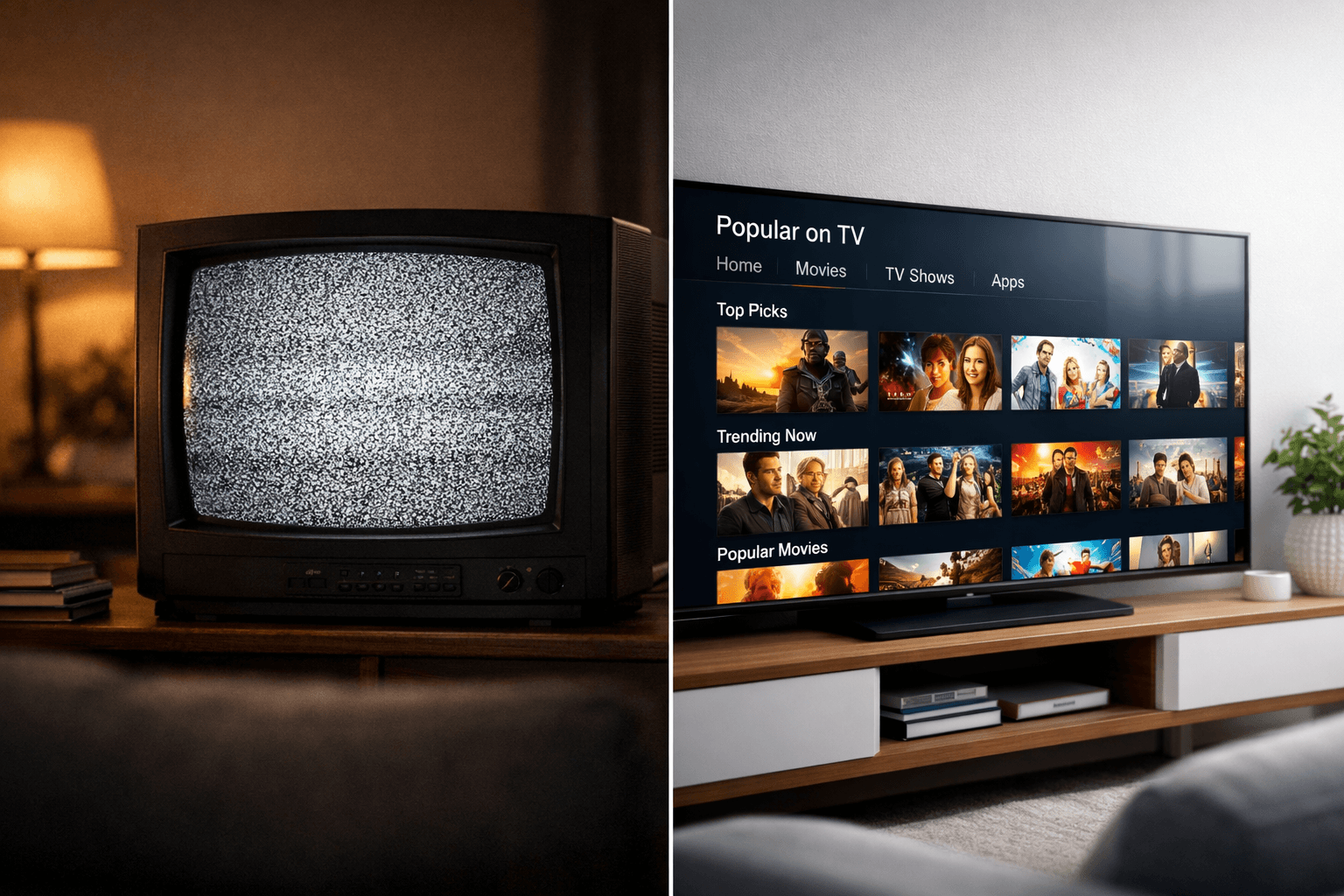
Connected TV (CTV) refers to advertising on internet-enabled television sets. In addition to smart TVs, this includes devices such as streaming sticks or TV boxes that allow content to be streamed directly to the TV. For viewers, it remains television on the big screen. For advertisers, however, this creates an additional digital delivery and targeting framework that expands upon traditional TV advertising. The difference lies not in the screen, but in the precision.
While linear TV advertising is planned based on channels, contexts, and airtimes, Connected TV can be targeted more precisely—for example, by region, household characteristics, or within specific content contexts. At the same time, the technical capabilities for targeting specific audiences are constantly evolving.
Reach remains a key objective, but it is no longer merely built up; instead, it is managed in a more targeted manner.
Want to see how Connected TV can strategically complement your TV advertising? Click here to go directly to our CTV campaign planner.
Greater transparency and flexibility
Another key difference lies in the measurement and optimization logic. Linear TV advertising relies primarily on forecast-based and panel-based measurements. Connected TV, however, provides transparency into the actual impressions delivered. Ad placements and budget allocations can be tracked and adjusted during the campaign.
In this way, CTV enhances TV advertising with:
- greater transparency
- more flexible budget control
- targeted frequency control
- optimization across the entire marketing funnel
From building reach to the targeted activation of users—such as through website visits, app installations, or other interactions—the big screen can be used in a more nuanced way today than in the past.
Connected TV does not replace television; it makes it more controllable.
Traditional TV vs. Connected TV? The Real Answer
The comparison “traditional TV vs. connected TV” suggests an either/or choice. In reality, these are two planning approaches within the same medium.
Traditional TV offers rapid reach and maximum visibility. Connected TV complements these strengths with digital control, greater measurability, and more flexibility.
So, anyone planning TV advertising today isn’t choosing between “old” and “new.” What matters most is which control logic fits the specific campaign strategy.
What counts as traditional TV these days?
Traditionally, “traditional TV” refers to linear, schedule-based television with fixed broadcast times and clearly defined commercial breaks. This model remains an important channel for reaching audiences, especially for large-scale brand communication.
But the landscape has expanded. Streaming platforms, media libraries, and smart TV apps have created new distribution channels, while Connected TV opens up additional opportunities for playback and control.
This is also changing the definition of what many still understand as “traditional television.” The screen remains the same, but the logic behind it is becoming more digital.
Connected TV is therefore less a replacement for traditional TV and more of an evolution of it.
Conclusion: The big screen is here to stay – television is becoming more digital
TV advertising continues to be delivered on the big screen, regardless of whether it is broadcast linearly or via connected TV.
What has changed is the way it is planned, managed, and measured.
Connected TV enhances traditional TV advertising with precision, transparency, and flexible delivery. As a result, the big screen becomes not only a reach channel but also a strategically controllable component of modern media planning.
Television hasn’t gone away; it has evolved: The screen remains the same. The logic behind it is becoming more digital.